
How Much Protein Do You Need Per Day?
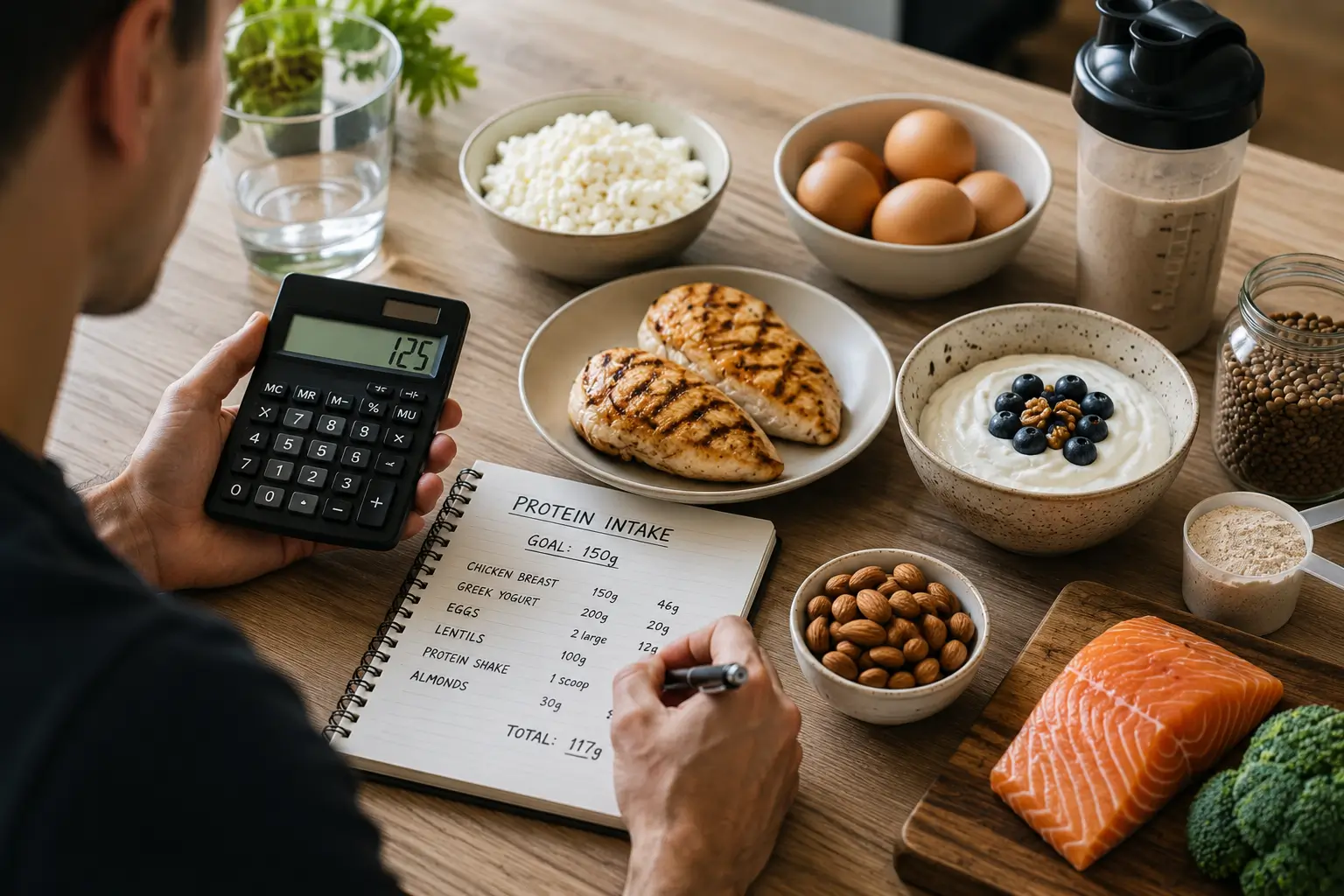
How Much Protein Do You Need Per Day?
If you are just starting fitness and wondering about your daily protein intake, use this simple rule: most active beginners do well with 0.7 to 0.9 grams of protein per pound of body weight (about 1.6 to 2.0 grams of protein per kg).
So if you weigh 160 pounds, a realistic daily protein target is 110 to 145 grams per day. That is usually enough to build muscle, support recovery, and keep you full, without turning your whole life into a chicken-and-shake routine.
In this guide, I will walk you through the exact formulas I use with new lifters, show you how to calculate protein per kg and per pound, and share the mistakes I see all the time. You will finish with a clear number, a simple eating plan, and zero guesswork.
Why does daily protein intake matter when you start fitness?
When you start working out, especially with weights, your body has one big job: break down muscle during training, then rebuild it stronger afterward. Protein is the raw material for that rebuild.
Get enough protein and you:
- Build muscle more easily
- Recover faster between workouts
- Feel fuller on fewer calories, which is great if you want to lose fat
- Hold on to muscle while dieting
Eat too little and you might feel tired, sore for days, and frustrated that your body is not changing even though you are showing up to the gym.
Most new lifters I talk to think they are “eating plenty of protein” because they have one big serving, like a large chicken salad at lunch. Then we track a full day and they end up at 50 to 70 grams total, which is far below what their training needs.
The basic protein formulas (quick reference)
Here are simple starting points for daily protein intake, based on your body weight and goal.
Protein per kg and per pound formulas
Use current body weight as a starting point.
| Goal / Activity Level | Protein per kg | Protein per pound |
|---|---|---|
| General health, light activity | 1.2, 1.6 g/kg | 0.55, 0.7 g/lb |
| Beginner lifting or regular training | 1.6, 2.0 g/kg | 0.7, 0.9 g/lb |
| Dieting, want to keep muscle | 1.8, 2.4 g/kg | 0.8, 1.1 g/lb |
If you are just starting fitness and training 3 to 5 days per week, aim for:
- 1.6 to 2.0 grams of protein per kg of body weight, or
- 0.7 to 0.9 grams of protein per pound of body weight
You do not need perfection. Pick a number in the middle and focus on hitting it consistently for several weeks.
How to calculate your daily protein intake using body weight
Let us run through real examples so you can plug in your own numbers. I will use three common starting points I see: someone at 140 lb, someone at 180 lb, and someone at 220 lb.
Step 1: Decide if you want protein per kg or per pound
You can use either:
- Protein per kg is great if you are used to metric or you like more precise numbers.
- Protein per pound is fast and easy, especially in the US.
I usually use per pound in casual conversation, then double-check with protein per kg if someone is dieting hard or doing a serious strength program.
Step 2: Choose your multiplier
If you are a beginner in the gym:
- Conservative start: 0.7 g per pound (1.6 g/kg)
- Middle ground: 0.8 g per pound (1.8 g/kg)
- Higher end: 0.9 g per pound (2.0 g/kg)
Pick based on your current size and appetite:
- If you struggle to eat enough, start at the low end.
- If you already eat a lot of protein-rich foods, aim for the middle.
- If you are dieting and do not want to lose muscle, use the higher end.
Step 3: Multiply by your body weight
Here are detailed examples.
Example 1: 140 lb beginner
- Weight: 140 lb (about 64 kg)
- Goal: Start lifting, maybe lose a little fat
- Multiplier: 0.8 g per pound
Calculation:
- 140 lb × 0.8 g/lb = 112 grams of protein per day
If you prefer protein per kg:
- 64 kg × 1.8 g/kg ≈ 115 grams of protein per day
Both methods land you in the same ballpark, which is what matters.
Example 2: 180 lb beginner
This is roughly where I started when I first got serious about lifting and tracking food.
- Weight: 180 lb (about 82 kg)
- Goal: Build muscle, stay around the same body weight
- Multiplier: 0.8 to 0.9 g per pound
Calculations:
- 180 lb × 0.8 g/lb = 144 g per day
- 180 lb × 0.9 g/lb = 162 g per day
I personally aimed for 150 g per day. It felt realistic once I spread it across three meals and one snack.
Protein per kg version:
- 82 kg × 1.8 g/kg ≈ 148 g per day
Again, very similar.
Example 3: 220 lb beginner
- Weight: 220 lb (about 100 kg)
- Goal: Lose fat, keep or build muscle
- Multiplier: 0.9 g per pound (on the higher side to help with fullness and muscle retention)
Calculations:
- 220 lb × 0.9 g/lb = 198 g per day
Protein per kg version:
- 100 kg × 2.0 g/kg = 200 g per day
This is a high intake, so if that feels overwhelming, you can start lower (like 170 to 180 grams), then work up.
Quick protein calculator reference guide
You can plug your own number into a protein calculator, but here is a short cheat sheet by weight for new lifters using about 0.8 g per pound.
| Body weight (lb) | Body weight (kg) | Daily protein (g) at ~0.8 g/lb |
|---|---|---|
| 120 lb | 54 kg | 95 g |
| 140 lb | 64 kg | 110 g |
| 160 lb | 73 kg | 130 g |
| 180 lb | 82 kg | 145 g |
| 200 lb | 91 kg | 160 g |
| 220 lb | 100 kg | 175 g |
Use this as a starting target. You can then adjust up or down by 10 to 15 grams based on hunger, recovery, and progress.
If you want a deeper breakdown of protein science, you can check the Ultimate Guide to Protein article after this.
How to spread your protein across the day
Hitting your daily protein intake is much easier if you do not try to cram 100 grams into one meal. Your muscles also respond well to repeated hits of protein through the day.
A simple pattern for beginners is:
- 3 main meals with 25 to 40 g of protein each
- 1 protein-focused snack with 15 to 30 g of protein
For example, when I was aiming for 150 g per day, a typical day looked like this:
- Breakfast: 2 whole eggs + 4 egg whites + toast (about 35 g)
- Lunch: Greek yogurt bowl with berries and granola (about 30 g)
- Snack: Whey shake with milk (about 30 g)
- Dinner: 5 oz chicken thigh, rice, veggies (about 55 g)
That is 150 grams without anything extreme.
You can build similar days around foods you already like.
How much protein can you use per meal?
You might have heard that your body can only use 20 or 30 grams of protein per meal. That is not quite right.
Research suggests that muscle protein synthesis is maximized around 0.25 to 0.4 g per kg per meal for most people, depending on age and training [cite: authoritative source]. For a 70 kg person, that is roughly 18 to 28 grams.
However, that does not mean extra protein is wasted. Your body can still use it for other functions, just not exclusively for muscle building in that moment.
For a new lifter, a realistic range is:
- 20 to 40 grams of protein per meal for most meals
- Slightly higher at the meal closest to your workout if you like
So do not panic if dinner ends up at 45 grams and your lunch had 22. The daily total is the priority.
Protein sources that make hitting your target easier
If you are aiming for 100 to 160 grams of protein per day, you will likely need at least 1 or 2 “protein anchor” foods in each meal.
Here are approachable options, with rough protein amounts per serving:
Animal-based protein sources
- Chicken breast, cooked: ~26 g per 3 oz
- Chicken thigh, cooked: ~22 g per 3 oz
- Ground beef (90% lean), cooked: ~22 g per 3 oz
- Turkey breast, cooked: ~25 g per 3 oz
- Pork loin, cooked: ~23 g per 3 oz
- Salmon, cooked: ~22 g per 3 oz
- Tuna (canned in water): ~20 g per 3 oz
- Eggs: ~6 g per large egg
- Greek yogurt (plain, nonfat): ~17 g per 6 oz
- Cottage cheese (low-fat): ~14 g per 1/2 cup
- Whey protein powder: ~20 to 25 g per scoop (check your label)
Plant-based protein sources
- Tofu (firm): ~9 g per 3 oz
- Tempeh: ~16 g per 3 oz
- Lentils, cooked: ~9 g per 1/2 cup
- Black beans, cooked: ~8 g per 1/2 cup
- Chickpeas, cooked: ~7 g per 1/2 cup
- Edamame, shelled: ~9 g per 1/2 cup
- Seitan: ~20 g per 3 oz
- Soy or pea protein powder: ~20 to 25 g per scoop
Plant-based eaters can absolutely hit higher protein targets. It just requires a bit more planning and combining foods like beans plus grains, or tofu plus rice, to match the totals above.
Common protein mistakes beginners make
You can have the perfect protein calculator and still spin your wheels if you fall into these traps. I see these repeatedly when people share their food logs.
Mistake 1: Only focusing on one “high protein” meal
Someone eats 50 grams of protein at dinner, but barely 10 grams at breakfast and lunch. Their daily total ends up too low and they feel hungry all afternoon.
Fix: Aim for at least 20 to 30 grams of protein in each main meal. Treat breakfast seriously. A bowl of cereal with almond milk will not cut it if you want to build muscle.
Mistake 2: Forgetting to track “hidden” low protein foods
A plate that looks high protein might not be. A giant salad with a tiny sprinkle of chicken, or a burrito that is mostly rice and cheese, can trick you.
I remember logging my “high protein burrito” at a restaurant and realizing it had 18 grams of protein and over 70 grams of carbs. Tasty, yes. High protein, not really.
Fix: Use a food tracking app for a week. Log your usual meals and see how much protein you are really getting.
Mistake 3: Chasing perfection instead of consistency
People get overwhelmed trying to hit 143 grams, on the dot, every day. If they land at 120 grams they feel like they failed, then give up.
Fix: Give yourself a range, not a single magic number. For example, if your target is 140 grams, try to land between 125 and 155 grams most days. That 20 to 30 gram window is fine.
Mistake 4: Going to extremes with protein
On one side, some people fear protein will “hurt their kidneys” if they eat more than 80 grams. On the other side, some think they need 300 grams daily because a bodybuilder on social media said so.
For healthy people with normal kidney function, higher protein diets (at the ranges we are talking about) are safe [cite: authoritative source]. If you have kidney disease or another medical condition, you should work with your doctor or dietitian.
Fix: Stay within evidence-based ranges: roughly 1.2 to 2.4 g per kg for active people. No need to double that.
Mistake 5: Ignoring total calories
Protein helps with recovery and fullness, but it does not override total calories. You can hit 180 grams of protein and still gain fat if your overall calorie intake is very high.
Fix: Once your protein is set, adjust carbs and fats to match your calorie goal. If your main goal is fat loss, start with a small calorie deficit while keeping protein high.
Adjusting your protein: when and how much
Your first protein target is a starting point, not a lifetime sentence. You can adjust it based on how you feel and what your progress looks like.
Ask yourself these questions after 3 to 4 weeks:
- Are you recovering well between workouts, or always sore and sluggish?
- Are you slowly gaining strength or muscle, or completely stuck?
- Are you constantly hungry, even when calories seem reasonable?
Potential tweaks:
- If you are always sore and struggling to progress, add 10 to 20 grams per day.
- If you are very full and find it hard to eat enough calories, reduce by 10 to 15 grams.
- If you are dieting and feeling very hungry, you might bump protein slightly higher and trim a bit of carbs or fat to keep calories in check.
Think of it like tuning a radio. Small changes. Give each change at least 1 to 2 weeks before judging it.
What about rest days and cardio-only days?
On days you do not lift, your muscles are still repairing and adapting. That process can last 24 to 48 hours after a workout [cite: authoritative source].
For beginners, I recommend:
- Keep protein about the same on rest days.
- You can slightly lower carbs on lighter days if you want, but do not cut protein.
If you only do light cardio and steps, you still benefit from a solid protein intake, especially if fat loss or muscle tone is a goal.
Sample one-day high protein menu for beginners
Here is a realistic 140 to 150 gram protein day for a 160 to 180 lb beginner. Adjust portion sizes for your needs.
Breakfast (35 g)
- 2 whole eggs scrambled
- 4 egg whites
- 1 slice whole grain toast
- 1 small orange
Lunch (35 g)
- 5 oz grilled chicken breast
- 1 cup cooked rice
- 1 to 2 cups mixed veggies
- Salsa or hot sauce for flavor
Snack (25 g)
- 1 scoop whey protein
- 1 cup 2% milk, or water if you prefer
- Optional: 1 banana
Dinner (45 g)
- 5 oz salmon fillet
- 1 medium baked potato
- Steamed broccoli with a little olive oil
Total protein: roughly 140 to 150 grams.
If you are vegetarian, you could swap chicken for tofu, salmon for tempeh, and whey for a pea or soy protein shake while keeping similar totals.
Do you need protein shakes to hit your daily protein intake?
Short answer: no, shakes are not required. They are just convenient.
Protein powders like whey, casein, or plant-based blends can help if:
- You are short on time and need something fast
- You do not have a big appetite in the morning
- You travel a lot, or work long shifts without easy access to full meals
I like to think of shakes as a “protein seatbelt.” Useful, very convenient, but not the main engine of your progress. Try to get at least half, if not more, of your daily protein from whole foods.
FAQ: Daily protein intake for beginners
How much protein do I need per day to build muscle as a beginner?
Most beginners do well with 0.7 to 0.9 grams of protein per pound of body weight (1.6 to 2.0 g/kg). So if you weigh 150 lb, that is about 105 to 135 grams per day. You do not need an extreme amount. Just hit that range consistently and train hard.
Is 100 grams of protein a day enough?
It depends on your size and training. For someone around 120 to 140 lb who is lifting, 100 grams is often enough. For someone 180 to 200 lb, 100 grams is probably low for optimal muscle gain. Use the protein per kg or per pound formulas to set a better target.
Can I eat too much protein?
If you have healthy kidneys and no underlying medical conditions, intakes in the range of 1.2 to 2.4 g/kg for active people are considered safe [cite: authoritative source]. Very high intakes far above that are unnecessary for most people. If you have kidney disease or another medical issue, speak with your doctor or a dietitian.
Do I need more protein on workout days?
You do not need a completely different number. Most people keep their daily protein intake similar on workout and rest days. You can shift timing so that you have a protein-rich meal or shake in the few hours after training, but the total daily amount matters most.
Is plant protein as good as animal protein?
You can absolutely build muscle with plant-based protein. Some plant proteins are lower in certain amino acids, so it helps to mix sources (for example, beans with rice, or tofu with grains) and aim for the higher end of the recommended protein range. Using a high quality plant protein powder can also make it easier to hit your daily target.
What if I cannot hit my protein goal every day?
You do not need to be perfect. Aim to hit your target or come close at least 5 out of 7 days. If you regularly fall short by 30 to 40 grams, your target might be too aggressive for your current habits. Lower it slightly, get consistent there, then increase by 10 to 15 grams when you feel ready.
Ready to see these numbers turned into actual meals for your body and goals? Build a personalized, high protein plan in minutes with FitPlate at /plan.
Ready to eat smarter?
Put this into practice with a personalized weekly meal plan built around your goals and preferences.
Generate your free meal plan
Written by
Sara Mitchell
Nutrition Writer
Sara writes about everyday nutrition and weight loss for people who do not have time to overthink food. She spent years testing meal-prep routines on a busy schedule and mostly cares about what people can actually keep doing on a Tuesday night. Expect plain advice, real portion sizes, and no miracle claims.
Related posts
10 Cheap High-Protein Foods (With Cost Per Serving)
A practical breakdown of 10 cheap high-protein foods in the US, with real cost-per-serving estimates, protein per serving, and smart shopping tips.
Ultimate Guide to Protein: Benefits, Intake, And Best Foods
A practical protein guide for adults that explains what protein is, how much you need, the real benefits, the best protein foods, and the biggest myths.
12 Budget-Friendly Foods That Are High in Protein
Discover 12 affordable protein sources that help you maintain a high-protein diet without overspending. Perfect for college students and budget-conscious eaters.